


All parents are required to provide financial support to their children. This obligation applies to all parents, whether they are married, in a relationship, or separated. All parents are also required to support their children, whether or not they live with them, and regardless of whether they have regular contact.
Child support is usually a regular, ongoing payment made by one parent to the other for the benefit of the child. In Ontario, child support is commonly determined under the Child Support Guidelines and may be set out in a separation agreement, court order, or divorce order. In many cases, the amount depends heavily on the paying parent’s income, the number of children, and the parenting arrangement. If you are trying to understand your rights or obligations, speaking with a Toronto child support lawyer can help you assess the facts of your situation.
This article explains what child support is intended to cover in Ontario, including both basic monthly support and additional special expenses.
Key Takeaways: Features of Child Support in Ontario
- Child support is intended to help cover the ordinary costs of raising a child, including expenses such as food, clothing, housing, utilities, transportation and routine school-related costs.
- The amount of basic child support is generally determined using the applicable Child Support Guidelines, with income, the number of children and the parenting arrangement among the key considerations.
- Some costs may qualify as Section 7 special or extraordinary expenses, which are considered separately from the basic monthly table amount.
- The parent receiving basic child support does not generally have to provide a receipt-by-receipt accounting showing exactly how every dollar was spent.
- Seeing the recipient parent spend money on personal expenses does not, by itself, mean child support is being misused, because support contributes to broader household expenses that benefit the child.
- A paying parent should not simply stop or reduce child support because they disagree with the recipient’s spending. If circumstances have changed, the proper approach is generally to seek a formal variation or updated agreement.
- If there are genuine concerns that a child’s needs are not being met, or that claimed Section 7 expenses are inaccurate, it may be appropriate to speak with a Toronto child support lawyer.
What is Child Support and How Does it Work in Ontario?
Child support is a legal obligation of every parent, regardless of the family’s living arrangements. This includes biological parents, adoptive parents, and in some cases, even step-parents. Depending on whether the matter falls under the Family Law Act or the Divorce Act, the legal framework may differ slightly, but the core principle is the same: children are entitled to financial support from their parents.
In most cases, child support starts with the applicable table amount. The federal child support tables were updated effective October 1, 2025, which makes it especially important to ensure any calculation is based on the correct version of the tables. Parents sometimes make arrangements in a separation agreement, but where there is a dispute, a judge may decide the amount based on the governing legislation, the evidence, and the child’s best interests.
For many families, child support issues do not end once an order is made. Support may need to be updated if income changes, if parenting time changes, or if a child develops new needs. There are also out-of-court services in some cases that can help calculate or update support amounts more efficiently.
How Is Child Support Calculated In Ontario?
The starting point for child support is generally the applicable Child Support Guidelines table.
For many families, the basic table amount depends primarily on:
- The paying parent’s annual income
- The number of children requiring support
- The applicable province or territory
Additional factors can affect the final amount. For example, a different analysis may be required where parents share substantial parenting time, a parent’s income exceeds $150,000, income is disputed, or Section 7 special or extraordinary expenses are involved.
Parents looking for an initial estimate can use our Ontario Child Support Calculator. A calculator provides an estimate and may not account for every circumstance that can affect a support obligation.
Who Is Responsible for Paying Child Support?
The Family Law Act and Divorce Act define who is considered to be a parent and who may be legally required to pay child support. These individuals may include:
- Birth parents,
- Adoptive parents,
- Step-parents, and
- Other individuals with a parent-like relationship with the child.
While it may be obvious that birth parents and adoptive parents are generally required to financially support their children, step-parent claims can be more complex. In some situations, a court may find that a step-parent showed a “settled intention” to treat a child as a member of their family. When that happens, child support may still be claimed depending on the specific history of the relationship and the legal test that applies.
Issues involving adult children can also become more complicated. A support obligation does not always end automatically when a child turns 18. For example, support may continue where a child remains dependent because of full-time studies, illness, disability, or other recognized reasons.
What Expenses Is Child Support Supposed to Cover in Ontario?
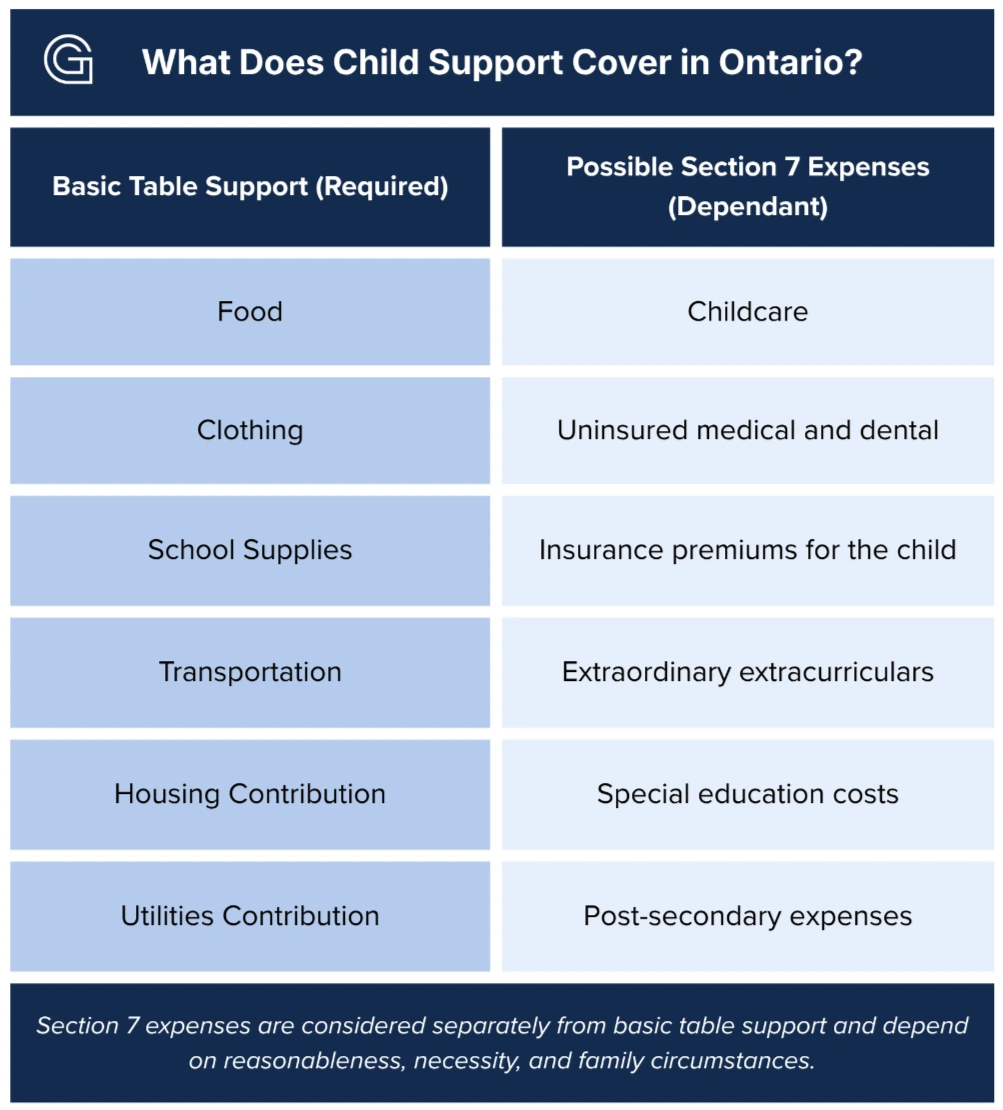
Ontario law stipulates that child support should be provided to cover the basic costs of caring for a child and providing them with necessities, including food, clothing, school costs, transportation costs, and a portion of housing and utility costs.
In other words, basic child support is meant to contribute to the routine costs of everyday life. It is not limited to one specific bill or one category of spending. Instead, it is designed to help ensure that a child’s basic needs are met on an ongoing basis.
This is one reason support disputes can arise even where one parent believes they are already paying for certain items directly. Paying for a few isolated expenses does not necessarily replace a formal child support obligation. If child support has not been properly addressed in an agreement or order, it is important to obtain legal guidance before making assumptions about what is or is not covered.
What Are Section 7 Special or Extraordinary Expenses?
In addition to the basic table amount, the Child Support Guidelines state that certain special expenses should be considered when calculating child support payments. This is to serve the best interests of the child. The special expense should also be “reasonable” in light of the parents’ income and previous family spending habits.
These special or extraordinary expenses may include:
- Child care expenses related to a parent’s employment, illness, disability, education, or employment training
- The portion of medical and dental insurance premiums attributable to the child
- Certain health-related expenses that are not reimbursed by insurance
- Extraordinary primary or secondary school expenses or educational programs that meet the child’s particular needs
- Post-secondary education expenses
- Extraordinary extracurricular expenses, including certain sports, arts, camps, or specialized activities
Whether a particular expense qualifies depends on factors such as the child’s needs, the reasonableness of the expense in light of the family’s financial circumstances, and the family’s spending pattern before separation.
Does Child Support Cover Daycare?
Daycare and other child care costs are not necessarily covered by the basic monthly child support amount.
Under Ontario’s Child Support Guidelines, qualifying child care expenses can be treated as Section 7 special or extraordinary expenses where they are incurred because of the employment, illness, disability, education, or employment training of the parent with the majority of parenting time.
These expenses are considered separately from the basic table amount and may be shared between the parents based on the applicable Guidelines calculation.
If you are unsure whether a particular daycare, before-school, after-school, or summer child care expense qualifies, our Toronto child support lawyers can help you understand how the Guidelines may apply.
What Does Child Support Not Cover in Ontario?
Basic monthly child support is intended to contribute to a child’s ordinary day-to-day needs. Certain additional costs may fall outside the basic table amount and instead be considered separately as Section 7 special or extraordinary expenses.
Depending on the circumstances, these may include qualifying child care, uninsured health expenses, post-secondary education, extraordinary educational costs, or extraordinary extracurricular activities.
Not every additional expense automatically qualifies as a Section 7 expense. The expense must satisfy the applicable requirements under the Child Support Guidelines.
Can Child Support Change Over Time?
Yes. Child support is not always a fixed amount forever. Support can often be changed if there has been a material change in circumstances, such as a significant change in income, a change in parenting time, or a change in the child’s needs.
This is one reason it is important for parents to exchange up-to-date financial disclosure and to review support arrangements regularly. An amount that was appropriate two years ago may no longer reflect current income or the child’s present needs.
Does Parenting Time Affect Child Support?
It can, depending on the circumstances. Parenting arrangements can affect how child support is calculated.
Where each parent has at least 40% of the parenting time with a child over the course of a year, the Child Support Guidelines require consideration of:
- The applicable table amounts for both parents
- The increased costs associated with shared parenting
- The financial circumstances of each parent and the child
A 40% parenting arrangement does not automatically eliminate child support.
For a more detailed explanation, read our guide to shared parenting time and the 40% rule in Ontario.
What Happens If Child Support Is Not Paid?
Where child support is set out in a court order, it is commonly filed with Ontario’s Family Responsibility Office, which is responsible for enforcing support payments. The FRO has a range of enforcement tools for payments that fall into arrears. Ontario also provides information for parents about paying and receiving child and spousal support and how support enforcement works.
Because enforcement can become serious very quickly, both payors and recipients should act promptly when payment problems arise. An experienced child support lawyer can advise you about your options when you do not receive the amount of child support you are legally entitled to.
What Happens If Your Ex Is Spending Child Support Payments on Themselves?
A common concern for parents who pay child support is whether the other parent is actually using the money for the child. You may see your former partner spending money on clothing, entertainment, travel, restaurants, or other personal expenses and wonder whether your child support payments are being misused.
In Ontario, basic monthly child support is generally not treated as a reimbursement system where the receiving parent must prove exactly how every dollar was spent. The table amount is intended to contribute to the overall cost of raising the child, including expenses such as housing, food, clothing, transportation, utilities and ordinary school-related costs. Ontario courts describe child support as money paid by one parent to the other for the financial support of the child, with the applicable amount generally determined under the Child Support Guidelines.
Because many child-related expenses are part of the household budget, it can be difficult to trace a particular child support payment to a particular purchase. For example, support may contribute toward rent or mortgage payments, groceries, electricity, transportation and other expenses that benefit both the child and the household.
As a result, seeing your former partner make a personal purchase does not, by itself, establish that child support is being improperly used.
Does the Parent Receiving Child Support Have to Provide Receipts?
For the ordinary monthly table amount, the receiving parent is not generally required to provide the paying parent with receipts showing how each child support dollar was spent.
Section 7 special or extraordinary expenses are different. These expenses are considered separately from basic table support and can include qualifying childcare, medical, dental, educational or extracurricular expenses. Ontario states that where an order or agreement includes special expenses, parents must provide information about the status and amount of those expenses.
This distinction is important. A parent may reasonably ask for documentation relating to a claimed Section 7 expense, but that does not mean they are automatically entitled to an accounting of every grocery bill, utility payment or other expense covered in part by regular child support.
Can You Stop Paying Child Support If You Think Your Ex Is Misusing It?
Generally, you should not simply stop, reduce or redirect court-ordered or agreed-upon child support payments on your own because you disagree with how you believe the recipient is spending the money.
Child support is a legal obligation owed for the benefit of the child. If an existing order is registered with Ontario’s Family Responsibility Office, unpaid amounts can become arrears and enforcement measures may follow.
If your concern is actually that your child’s basic needs are not being met, that can raise a different and potentially more serious issue than simply disagreeing with the other parent’s spending choices. Depending on the circumstances, it may be appropriate to document your concerns and speak with a Toronto child support lawyer about whether any legal steps are available.
Similarly, if circumstances affecting support have materially changed, such as a significant change in income or parenting arrangements, the appropriate approach is generally to seek a change to the child support arrangement rather than withholding payments unilaterally.
Can I Ask the Court to Make My Ex Prove Where Child Support Goes?
Ordinary table child support is designed to contribute to the general cost of raising a child and is not typically administered by requiring the recipient to produce a dollar-for-dollar accounting of everyday spending.
However, particular expenses can become relevant in certain disputes. For example, Section 7 expenses may require evidence concerning the nature and amount of the expense because the Child Support Guidelines require the court to consider whether qualifying expenses are necessary in relation to the child’s best interests and reasonable in relation to the parents’ means.
If you have evidence that goes beyond a disagreement about spending and suggests that your child is not receiving appropriate care or that a claimed expense is inaccurate, speak with a family lawyer about the particular facts before changing how support is paid.
Speak With Our Family Law Lawyers About Your Child Support Obligations Today
Children are entitled to financial support from their parents within that parent’s means and abilities. Ontario’s child support guidelines provide the basis for calculating required child support. Sometimes, the parents may use these guidelines to create an agreement governing child support, and sometimes a judge will issue a court order on the topic. In either case, counsel from experienced family lawyers can be extremely helpful.
At Gelman & Associates, our team helps clients understand child support rights and obligations under Ontario family law. To speak with a Toronto child support lawyer about your matter, contact Gelman & Associates at (844) 736-0200 to book a consultation.