


All parents are required to provide financial support to their children. This obligation applies to all parents, whether they are married, in a relationship, or separated. All parents are also required to support their children, whether or not they live with them, and regardless of whether they have regular contact.
Child support is usually a regular, ongoing payment made by one parent to the other for the benefit of the child. In Ontario, child support is commonly determined under the Child Support Guidelines and may be set out in a separation agreement, court order, or divorce order. In many cases, the amount depends heavily on the paying parent’s income, the number of children, and the parenting arrangement. If you are trying to understand your rights or obligations, speaking with a Toronto child support lawyer can help you assess the facts of your situation.
This article explains what child support is intended to cover in Ontario, including both basic monthly support and additional special expenses.
How Does Child Support Work in Ontario?
Child support is a legal obligation of every parent, regardless of the family’s living arrangements. This includes biological parents, adoptive parents, and in some cases, even step-parents. Depending on whether the matter falls under the Family Law Act or the Divorce Act, the legal framework may differ slightly, but the core principle is the same: children are entitled to financial support from their parents.
In most cases, child support starts with the applicable table amount. The federal child support tables were updated effective October 1, 2025, which makes it especially important to ensure any calculation is based on the correct version of the tables. Parents sometimes make arrangements in a separation agreement, but where there is a dispute, a judge may decide the amount based on the governing legislation, the evidence, and the child’s best interests.
For many families, child support issues do not end once an order is made. Support may need to be updated if income changes, if parenting time changes, or if a child develops new needs. There are also out-of-court services in some cases that can help calculate or update support amounts more efficiently.
Who Is Responsible for Paying Child Support?
The Family Law Act and Divorce Act define who is considered to be a parent and who may be legally required to pay child support. These individuals may include:
- Birth parents,
- Adoptive parents,
- Step-parents, and
- Other individuals with a parent-like relationship with the child.
While it may be obvious that birth parents and adoptive parents are generally required to financially support their children, step-parent claims can be more complex. In some situations, a court may find that a step-parent showed a “settled intention” to treat a child as a member of their family. When that happens, child support may still be claimed depending on the specific history of the relationship and the legal test that applies.
Issues involving adult children can also become more complicated. A support obligation does not always end automatically when a child turns 18. For example, support may continue where a child remains dependent because of full-time studies, illness, disability, or other recognized reasons.
What Expenses Is Child Support Supposed to Cover in Ontario?
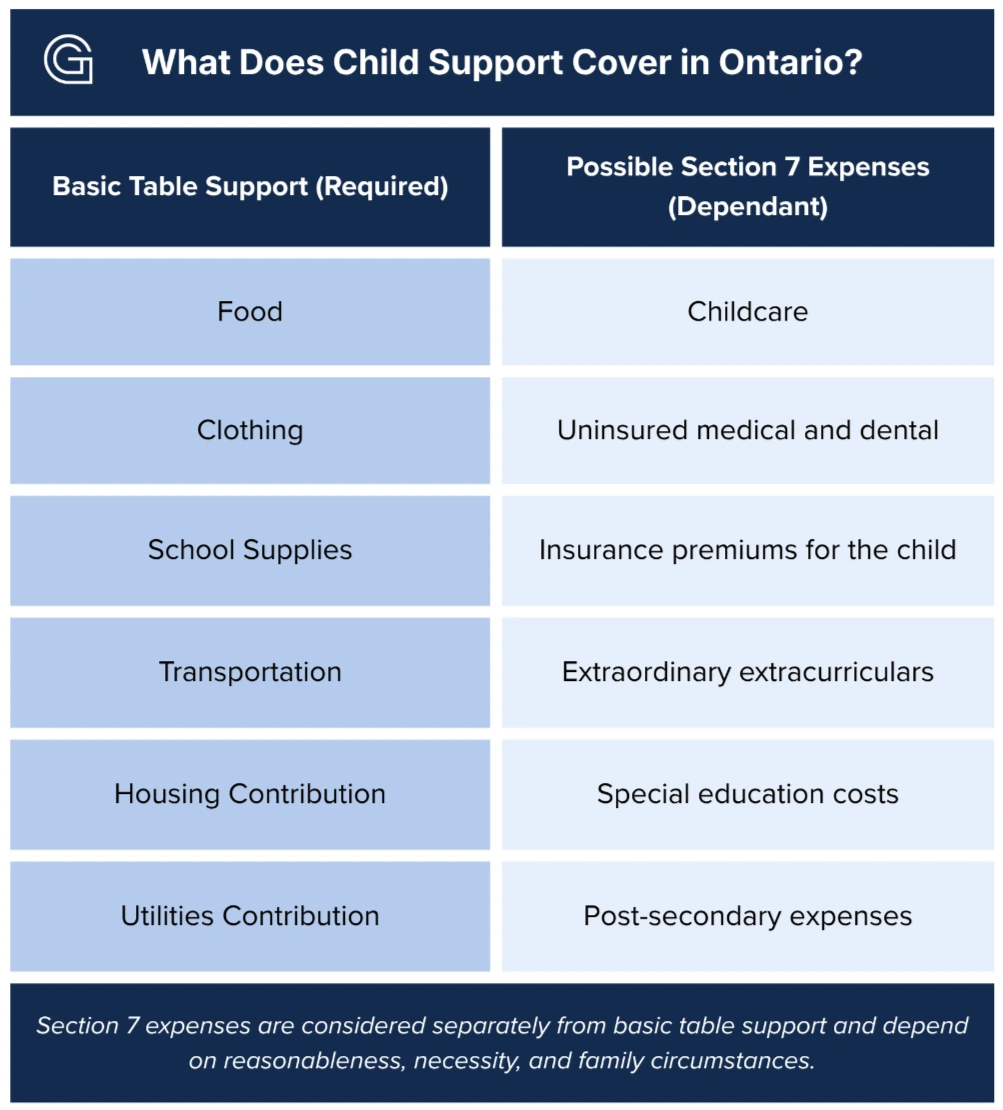
Ontario law stipulates that child support should be provided to cover the basic costs of caring for a child and providing them with necessities, including food, clothing, school costs, transportation costs, and a portion of housing and utility costs.
In other words, basic child support is meant to contribute to the routine costs of everyday life. It is not limited to one specific bill or one category of spending. Instead, it is designed to help ensure that a child’s basic needs are met on an ongoing basis.
This is one reason support disputes can arise even where one parent believes they are already paying for certain items directly. Paying for a few isolated expenses does not necessarily replace a formal child support obligation. If child support has not been properly addressed in an agreement or order, it is important to obtain legal guidance before making assumptions about what is or is not covered.
What Are Section 7 Special or Extraordinary Expenses?
In addition to the basic table amount, the Child Support Guidelines state that certain special expenses should be considered when calculating child support payments. This is to serve the best interests of the child. The special expense should also be “reasonable” in light of the parents’ income and previous family spending habits.
These special/extraordinary expenses may include:
- Medical and dental premiums;
- Uncovered healthcare costs;
- Extracurricular activities;
- Primary and secondary education costs;
- Childcare costs resulting from the employment, education, training, illness, or disability of the parent with the majority of the parenting time.
Can Child Support Change Over Time?
Yes. Child support is not always a fixed amount forever. Support can often be changed if there has been a material change in circumstances, such as a significant change in income, a change in parenting time, or a change in the child’s needs.
This is one reason it is important for parents to exchange up-to-date financial disclosure and to review support arrangements regularly. An amount that was appropriate two years ago may no longer reflect current income or the child’s present needs.
What Happens If Child Support Is Not Paid?
Where child support is set out in a court order, it is commonly filed with Ontario’s Family Responsibility Office, which is responsible for enforcing support payments. The FRO has a range of enforcement tools for payments that fall into arrears. Ontario also provides information for parents about paying and receiving child and spousal support and how support enforcement works.
Because enforcement can become serious very quickly, both payors and recipients should act promptly when payment problems arise. An experienced child support lawyer can advise you about your options when you do not receive the amount of child support you are legally entitled to.
Speak With Our Family Law Lawyers About Your Child Support Obligations Today
Children are entitled to financial support from their parents within that parent’s means and abilities. Ontario’s child support guidelines provide the basis for calculating required child support. Sometimes, the parents may use these guidelines to create an agreement governing child support, and sometimes a judge will issue a court order on the topic. In either case, counsel from experienced family lawyers can be extremely helpful.
At Gelman & Associates, our team helps clients understand child support rights and obligations under Ontario family law. To speak with a Toronto child support lawyer about your matter, contact Gelman & Associates at (844) 736-0200 to book a consultation.