
Child support can be one of the most important aspects of a separation or divorce. It helps ensure that children have the financial support they need to thrive, regardless of how their parents’ relationship changes. In Ontario, child support is considered the right of the child, not the parents. Parents cannot waive this responsibility, and support may be owed even in shared parenting arrangements where the parents spend significant or equal time with their children.
At Gelman & Associates, our child support lawyers in Toronto understand the financial, emotional, and practical stress that often accompanies these issues. We take time to listen, provide clear information, and help parents feel supported while navigating an often-overwhelming process. Our goal is to empower you with the knowledge you need to make thoughtful decisions during a challenging transition.
To speak with an experienced Toronto child support lawyer today, you can contact us online or call our office at 1-844-736-0200. We serve clients across Ontario.
Estimate Child Support With Our Ontario Child Support Calculator
Wondering how much child support may be payable in your circumstances?
Use the Gelman & Associates 2026 Child Support Calculator to get an estimate based on key information such as income and the number of children.
Use Our Ontario Child Support Calculator
A calculator can be a useful starting point, but it does not determine every child support issue. The appropriate amount may be affected by shared parenting arrangements, Section 7 expenses, income that is difficult to determine, self-employment, unusually high income, or other circumstances.
How Child Support Is Calculated in Ontario
Ontario uses the Federal Child Support Guidelines and the Ontario Child Support Guidelines to determine the appropriate amount of child support. These guidelines set out tables that link the payor parent’s before-tax annual income to the number of children, and then provide a basic monthly “table amount” of support for that family. The tables also take into account the province or territory where the paying parent lives, as tax rules and costs can vary across Canada.
In practical terms, this means that child support is not based on a detailed budget of what your specific child costs each month. Instead, courts and lawyers refer to the guideline tables to see what amount should normally be paid for a child in a family with a similar income level. Economic studies are used to inform these tables, and they are updated from time to time to reflect changes in tax rules and the cost of living in Ontario.
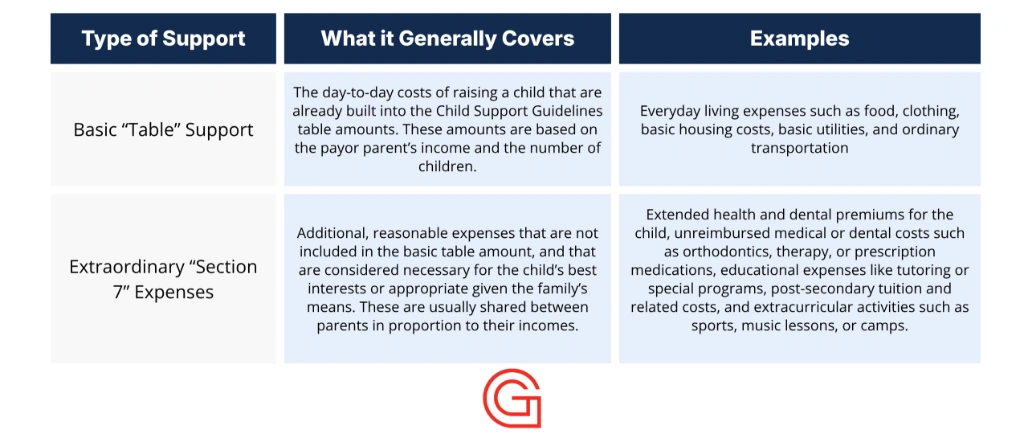
The basic table amount is intended to cover a child’s ordinary, day-to-day needs, including things like food, clothing, basic housing costs, utilities, and regular transportation. In many families, there may also be additional expenses that fall outside these everyday items, such as certain medical costs, child care, or post-secondary education.
For a quick estimate, parents can also use our 2026 Ontario Child Support Calculator. The calculator can help you identify a potential basic table amount, but a lawyer may still need to assess issues such as income determination, shared parenting, special expenses, or whether a different calculation applies.
In addition to the base (or “table”) amount, parents may also share certain additional costs called special or extraordinary expenses, often referred to as Section 7 expenses. These may include medical or dental insurance premiums for the child, health-related expenses such as orthodontics, therapy, or prescription medications, educational programs or tutoring, post-secondary education, and extracurricular activities such as music lessons, sports, summer camps, or specialized training.
These expenses are generally shared proportionately to each parent’s income. Understanding which expenses qualify, as well as how much each parent may be expected to contribute, can be confusing. Our Toronto child support lawyers can help you review your circumstances and understand your options.
What Are Section 7 Expenses In Ontario?
The basic child support table amount is intended to contribute to a child’s ordinary day-to-day expenses. Some families also have additional costs that may qualify as special or extraordinary expenses, commonly called Section 7 expenses.
Section 7 of Ontario’s Child Support Guidelines identifies several categories of expenses that may be added to the basic child support amount where the legal requirements are met.
These can include:
- Child care expenses connected with a parent’s employment, illness, disability, education, or employment training
- The portion of medical and dental insurance premiums attributable to the child
- Certain uninsured health-related expenses
- Extraordinary primary or secondary school expenses or educational programs addressing a child’s particular needs
- Post-secondary education expenses
- Extraordinary extracurricular expenses
An expense does not automatically become a Section 7 expense simply because it relates to a child. The court considers whether the expense is necessary in relation to the child’s best interests and reasonable in light of the means of the parents and child, as well as the family’s spending pattern before separation. Ontario’s Child Support Guidelines expressly require these considerations.
Are Section 7 Expenses Split 50/50?
Not necessarily.
The general principle under the Ontario Child Support Guidelines is that qualifying Section 7 expenses are shared in proportion to the parents’ respective incomes, after accounting for any contribution from the child.
For example, if one parent earns substantially more than the other, that parent may be responsible for a greater percentage of the qualifying expense.
The calculation can also need to account for subsidies, benefits, insurance reimbursements, and certain tax deductions or credits related to the expense.
What Counts As An “Extraordinary” Extracurricular Expense?
Not every sports fee, music lesson, camp, or extracurricular activity will automatically qualify.
When considering whether an educational or extracurricular expense is extraordinary, relevant factors can include:
- The cost of the activity
- The parents’ incomes
- The basic child support already being received
- The number and nature of the child’s activities
- The child’s particular needs or talents
- The family’s overall financial circumstances
For a more detailed discussion of higher-cost activities, read our guide to Section 7 expenses for competitive sports, arts, and other high-cost activities.
Do Parents Have To Agree Before A Section 7 Expense Is Incurred?
Whether advance agreement is required can depend on the wording of an existing court order or separation agreement and the circumstances surrounding the expense.
Where possible, parents should clearly address how proposed Section 7 expenses will be discussed, approved, documented, and reimbursed. Disputes often arise not only over whether an expense qualifies, but also over whether it was reasonable to incur it and what proportion each parent should pay.
Our Toronto child support lawyers can review an existing agreement or order and help determine how a proposed expense should be handled.
Table Support vs. Special or Extraordinary Expenses
Common Questions Our Toronto Child Support Lawyers Receive
Do parents have to pay child support even with 50/50 parenting time?
Yes, in some cases. Equal time with the children does not automatically eliminate child support obligations. If one parent earns more than the other, they may still owe support based on the difference between the parties’ incomes. Certain exceptions may apply, depending on the family’s circumstances.
Does child support cover university or post-secondary education?
Parents may be responsible for contributing to post-secondary costs, even after their child has turned 18. While every situation is unique, courts often expect both parents to help cover reasonable education expenses if they have the financial ability to do so.
How long does child support last?
Support generally continues until a child turns 18. However, it may continue longer if the child is still enrolled in full-time studies or is unable to withdraw from parental care due to health or disability-related reasons.
How accurate is an online child support calculator?
A child support calculator can provide a useful estimate of the basic table amount where income and the number of children are straightforward.
It may not provide a complete answer where there is shared parenting, self-employment, disputed income, Section 7 expenses, income over $150,000, or other circumstances requiring additional legal analysis.
You can begin with our Ontario Child Support Calculator and then speak with a family lawyer if you need advice about how the Guidelines apply to your circumstances.
Are Section 7 Expenses Included In The Child Support Calculator?
The basic table calculation and Section 7 expenses are separate concepts.
The table amount is generally based on income, the number of children, and the applicable province or territory. Qualifying Section 7 expenses can be payable in addition to the basic amount.
Can Child Support Go Up If The Paying Parent Gets A Raise?
A material increase in the income used to calculate child support may result in a higher guideline amount.
Whether and how the support should be updated depends on the existing agreement or court order, the financial disclosure exchanged, and the applicable recalculation or variation process.
Can Child Support Go Down If I Lose My Job?
A genuine and significant reduction in income may justify reviewing the existing child support amount, but support should not simply be reduced unilaterally.
Legal advice can help determine whether the circumstances support a variation and what evidence or process is required.
Can child support be enforced if a parent refuses to pay?
When a parent falls behind on their financial obligations, understanding what to do if child support is not paid in Ontario can help families identify the available enforcement options.
Ontario’s Family Responsibility Office (FRO) is responsible for collecting and enforcing child support payments. FRO may garnish wages, intercept tax refunds, suspend a driver’s licence, or take other enforcement steps where necessary.
Do step-parents ever have child support obligations?
A step-parent may have responsibilities if they showed a settled intention to treat the child as their own during the relationship. Whether support is owed depends on the family’s specific circumstances and the level of involvement.
Myths and Facts About Child Support in Ontario
Many parents come to us feeling overwhelmed by conflicting information. Here are some common myths our team at Gelman & Associates helps clients debunk. To clarify your legal rights and obligations when it comes to child support in Ontario, we recommend speaking with an experienced Toronto child support lawyer. Our team at Gelman & Associates can help you navigate your separation, divorce, and financial obligations.

When Can Child Support Be Changed In Ontario?
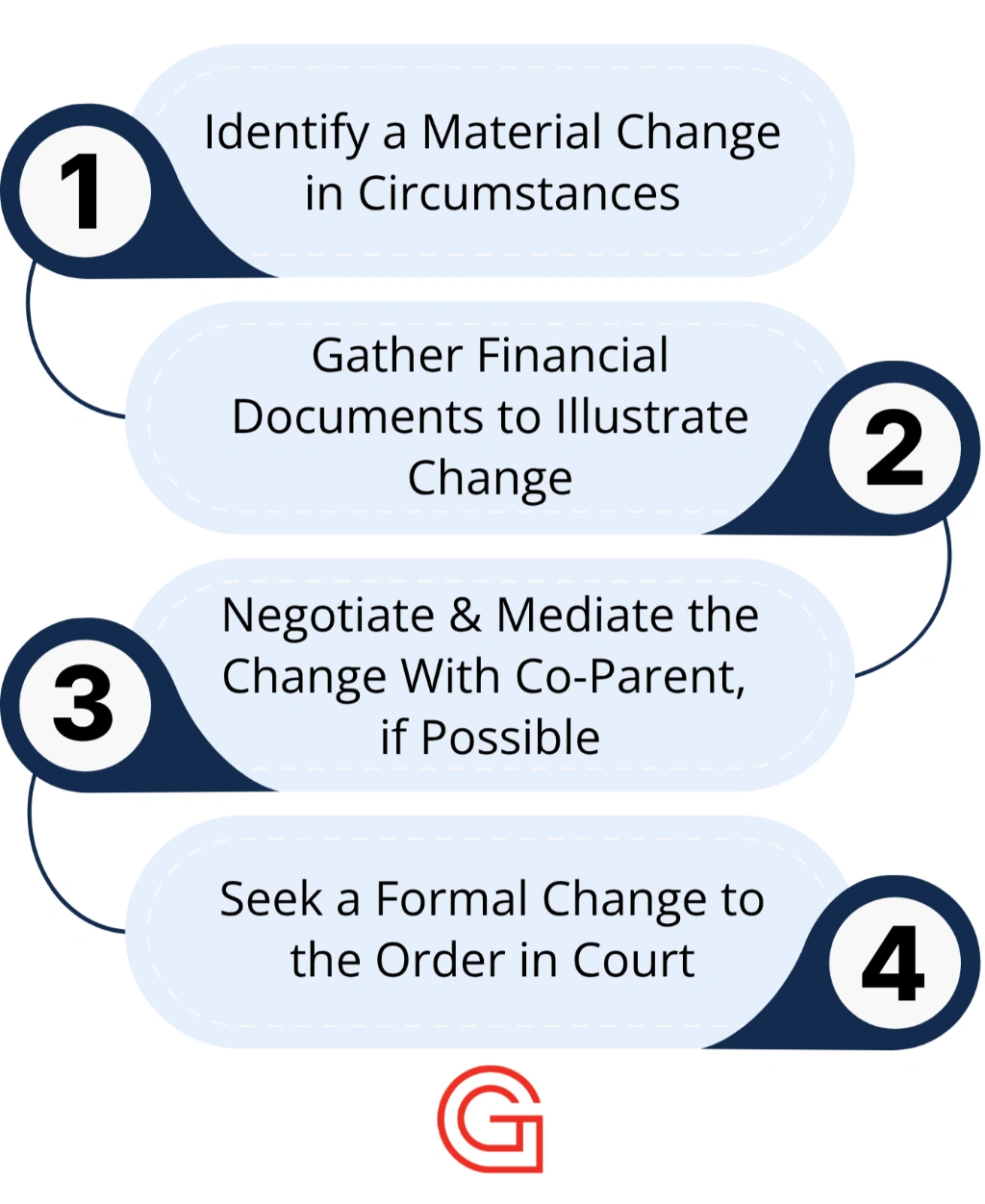
Life rarely remains static, and your child support arrangements may need adjustment over time. Whether your income changes, parenting arrangements shift, or a child begins post-secondary studies, it may be appropriate to revisit support obligations. Parents whose financial circumstances have changed may benefit from understanding when child support payments can be changed in Ontario and the legal process for updating an existing arrangement.
Potential reasons for reviewing support may include:
- A significant increase or decrease in income
- Job loss or a change in employment
- A parent becoming self-employed
- A change in parenting arrangements
- A child beginning or completing post-secondary education
- A child becoming financially independent
- New information about income that was not previously available
- Changes to qualifying Section 7 expenses
It may also be possible to end child support obligations when a child reaches a certain age, although whether this will be allowed depends on the child’s circumstances rather than age alone. Our guide explains when child support ends in Ontario and why payments may continue after age 18.
The appropriate procedure depends on whether support is contained in a separation agreement, court order, or another formal arrangement.
Does Child Support Change Automatically When Income Changes?
Not necessarily.
An income change does not mean that parents should simply begin paying a different amount without considering the existing agreement or order.
Parents may be able to agree on an updated amount and formalize the change. In other circumstances, a formal variation or recalculation process may be required.
Ontario also operates a Child Support Service that can set up or update child support online in eligible cases without requiring parents to attend court. Ontario confirms that the updated 2025 child support tables have applied to Ontario child support matters since October 1, 2025.
Where the online service is not available, or the parents disagree about the appropriate amount, other processes may be necessary. Parents whose child support obligations have changed may also have questions about recovering overpaid child support in Ontario and whether a retroactive adjustment is possible.
What Is A Motion To Change Child Support?
Where child support is contained in a court order and the parties cannot agree on a change, a parent may need to ask the court to vary the existing order.
A request to change support generally requires evidence showing why the existing arrangement should be reconsidered.
That may include updated:
- Income tax returns
- Notices of assessment
- Pay information
- Corporate or self-employment records
- Information about parenting arrangements
- Evidence concerning a child’s education or expenses
The evidence required will depend on the reason for the requested change.
Our Toronto variation order lawyers assist clients seeking or responding to requests to change existing child support arrangements.
Can Child Support Be Changed Retroactively?
In some cases, a parent may seek an adjustment relating to an earlier period rather than only changing support going forward.
Retroactive child support can be legally complex. Issues may include when income changed, when the other parent was notified, what financial disclosure was provided, the history of payments, and the circumstances of the child and both parents.
Anyone seeking significant retroactive support, or facing a request for substantial arrears or repayment, should obtain legal advice based on the specific facts rather than assuming the current table amount can simply be applied backward.
What If Parents Agree To Change Child Support?
Parents may sometimes resolve an updated child support amount through negotiation or family mediation.
However, the change should be properly documented. Informal arrangements can create uncertainty later, particularly if an existing court order remains in place or support is being enforced through the Family Responsibility Office.
A family lawyer can help ensure that the revised arrangement is properly recorded and determine whether any additional filing or court steps are required.
How Our Toronto Child Support Lawyers Support You
At Gelman & Associates, we recognize how stressful it can feel to manage financial issues while caring for your children. Our team offers a calm and compassionate approach, helping clients across Toronto and the GTA understand their rights and responsibilities during separation or divorce.
Comprehending child support obligations and amounts can get complicated, especially in situations where parents are self-employed or spend equal amounts of time with their children. That’s why we assist with understanding guideline calculations, reviewing and negotiating Section 7 expenses, and addressing income disclosure concerns.
We can also offer legal assistance when it comes to seeking or responding to requests for support changes, navigating enforcement issues, and connecting child support with other family law matters, such as parenting arrangements, spousal support, and divorce
You will also receive access to our helpful handbooks, resources, and personalized guidance throughout the process. Our goal is to ensure you feel informed and supported at every step.
Speak With A Toronto Child Support Lawyer About Your Calculation
Whether you are determining child support for the first time, disputing income, dealing with Section 7 expenses, or trying to change an existing support arrangement, understanding the correct calculation can have significant financial consequences for your family.
You can begin by using our 2026 Ontario Child Support Calculator for an initial estimate.
For advice specific to your circumstances, the Toronto child support lawyers at Gelman & Associates can help you:
- Review the guideline child support calculation
- Determine what income should be used
- Assess shared parenting arrangements
- Identify and calculate Section 7 expenses
- Seek or respond to a child support variation
- Address disclosure issues
- Deal with enforcement or arrears
- Formalize an agreed change in support
Call 1-844-736-0200 or contact Gelman & Associates online to book a consultation with a Toronto child support lawyer.